
How to Measure AI ROI: What to Track and What to Ignore
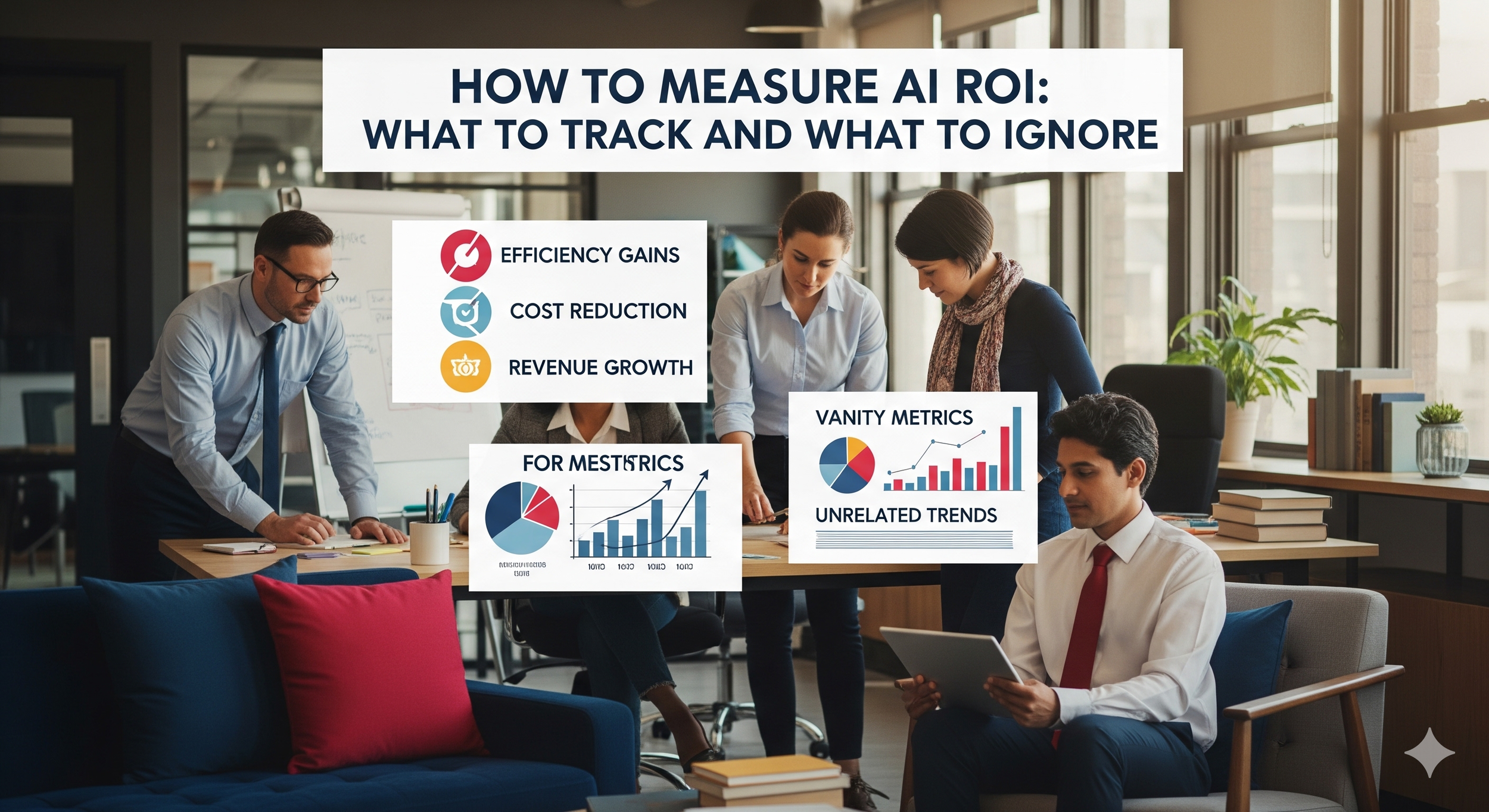
AI investment is increasing across most mid-sized businesses. So is the pressure to demonstrate that it's working. But measuring the return on AI investment is harder than measuring most technology investments — and the most natural approach (applying traditional ROI frameworks directly) often produces misleading results that either undervalue what AI is delivering or, worse, justify continued investment in initiatives that aren't actually generating value.
Understanding how to measure AI ROI properly is increasingly important for business leaders who need to make resource allocation decisions and justify AI investment to boards and leadership teams.
Why is measuring AI ROI so difficult?
Three structural features of AI adoption make measurement more complex than traditional technology investment.
First, AI benefits are often diffuse. A CRM with AI-powered lead scoring doesn't generate a line item in your accounts. It improves the conversion rate of a process that involves multiple people, tools, and inputs. Attributing a specific financial outcome to the AI component specifically — rather than to the sales team, the product, the pricing, or other variables — requires careful measurement design.
Second, AI value accrues over time in ways that don't show up in short-term measurement windows. An organisation that invests in AI capability in year one may not see the full financial impact until year two or three, as the capability matures, skills develop, and AI is integrated more deeply into core processes. Applying a 90-day ROI lens to a multi-year capability investment will always produce disappointing results.
Third, some of the most significant AI value is in things that are hard to quantify: decision quality, employee satisfaction, risk reduction, and competitive positioning. These matter to the business but don't show up cleanly in a standard ROI calculation.
What are the right metrics for AI adoption success?
Effective AI measurement uses a layered framework that tracks metrics at three levels: adoption, performance, and business impact.
Adoption metrics measure whether AI is actually being used: active user rates, tool engagement, feature utilisation, and training completion. These are leading indicators — low adoption tells you early that value realisation is at risk, before it shows up in business metrics. Gartner research suggests that tracking adoption within the first 90 days of deployment is one of the strongest predictors of long-term AI programme success.
Performance metrics measure whether AI is doing what it's supposed to do: accuracy rates, error rates, processing times, output quality scores. These vary by use case but should be defined specifically for each AI application. A content generation tool should have quality metrics; a predictive analytics tool should have accuracy metrics; a process automation should have throughput and error rate metrics.
Business impact metrics measure what the AI investment is delivering at the commercial level: revenue impact, cost reduction, time savings converted to capacity, customer satisfaction improvements, and risk reduction. These are the metrics that matter most to leadership and boards, and they require the most careful measurement design to attribute correctly.
How do you build an AI measurement framework?
The most common mistake is trying to measure everything. An effective AI measurement framework focuses on the metrics that matter most for each specific initiative, measured consistently over a meaningful time period.
The framework should be designed before the AI initiative launches, not retrofitted afterwards. This means: defining the specific business outcome the AI investment is intended to deliver; identifying the metrics that will indicate whether that outcome is being achieved; establishing baseline measurements before the AI goes live; defining the measurement cadence (how often, who is responsible, how results are reported); and agreeing on the performance threshold that constitutes success.
For most mid-sized businesses, a simple dashboard tracking 4–6 key metrics per major AI initiative is more useful than a comprehensive measurement system. The goal is decision-useful data — information that tells leadership whether an AI investment is performing as expected and what, if anything, needs to change.
What does good AI ROI look like for a mid-sized business?
Based on research from McKinsey and Deloitte, mid-sized businesses that execute AI adoption well can typically expect measurable productivity improvements of 15–40% in targeted processes within 12–18 months, cost reductions of 10–30% in automated functions, and revenue impact through improved conversion rates, customer retention, or new capability in the range of 5–15%. These ranges are wide because the specific outcome depends heavily on the use case, the quality of the data, and the effectiveness of the adoption programme.
The single most important predictor of AI ROI isn't the technology chosen — it's the completeness of the adoption approach. Businesses that invest in strategy, technology, and people in combination consistently outperform those that invest in technology alone. This is consistently the most important finding in the research on AI adoption outcomes, and it's the experience we see in practice.
Measurement is itself part of a complete adoption approach. Businesses that measure rigorously, learn from what the data tells them, and adjust their approach accordingly are the ones that turn initial AI investments into compounding advantage over time.
Frequently Asked Questions
When should we start measuring AI ROI? Measurement should start before the AI initiative launches, with baseline data. Adoption metrics should be tracked from day one of go-live. Performance metrics typically take 4–8 weeks to stabilise as users become proficient and the AI system learns from live data. Business impact metrics should be assessed at 3, 6, and 12 months, with the expectation that the 12-month data will be the most meaningful.
What's a realistic timeframe for positive AI ROI? For well-executed initiatives targeting clear productivity or cost outcomes, positive ROI within 6–12 months is achievable. For more complex capability-building programmes, 12–18 months is more realistic. The key variable is whether the investment was scoped correctly in the first place — AI initiatives with vague or over-broad objectives consistently take longer to deliver measurable returns than those with specific, well-defined success criteria.
Who should own AI measurement in the business? AI measurement is most effective when owned jointly by the business leader of the function where the AI is deployed and the team managing the AI adoption programme. The function leader owns the business impact metrics (they're accountable for the commercial outcome); the adoption team owns the adoption and performance metrics. Where these two groups review data together regularly, the feedback loop between technical performance and business outcome is much tighter, and course-correction happens faster.
Not sure where your business stands with AI?
Find out your AiDOPTION Score — a free 10-minute diagnostic that measures your AI readiness across Strategy, Technology, and People. You'll get a personalised score and practical recommendations.