

The AiGILE Blog
Browse our latest articles
Want the AI insights that don't make the headlines?
BRAiKING NEWS lands in your inbox before the hype does.
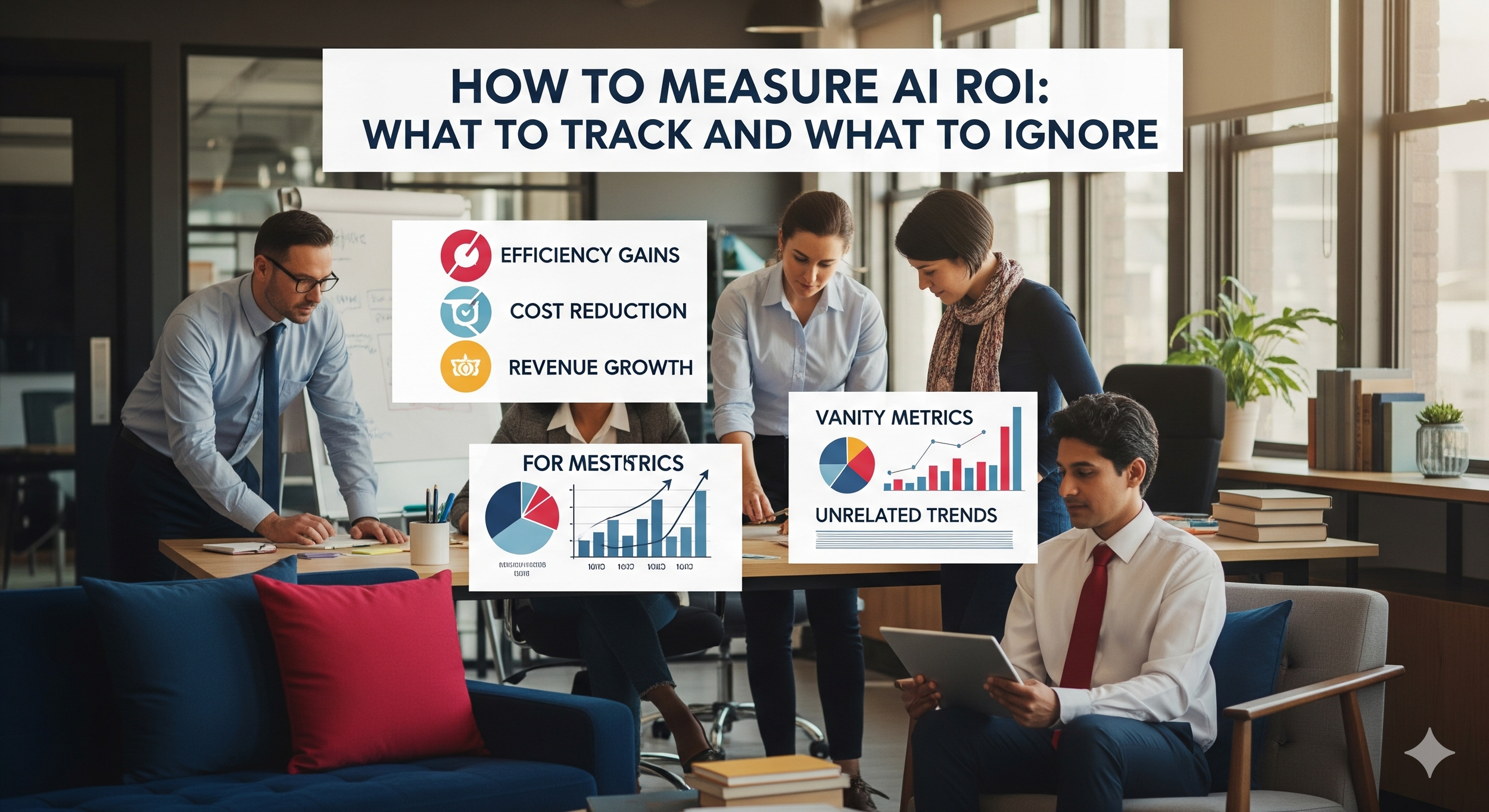
How to Measure AI ROI: What to Track and What to Ignore
AI investment is increasing across most mid-sized businesses. So is the pressure to demonstrate that it's working. But measuring the return on AI investment is harder than measuring most technology investments — and the most natural approach (applying traditional ROI frameworks directly) often produces misleading results that either undervalue what AI is delivering or, worse, justify continued investment in initiatives that aren't actually generating value.
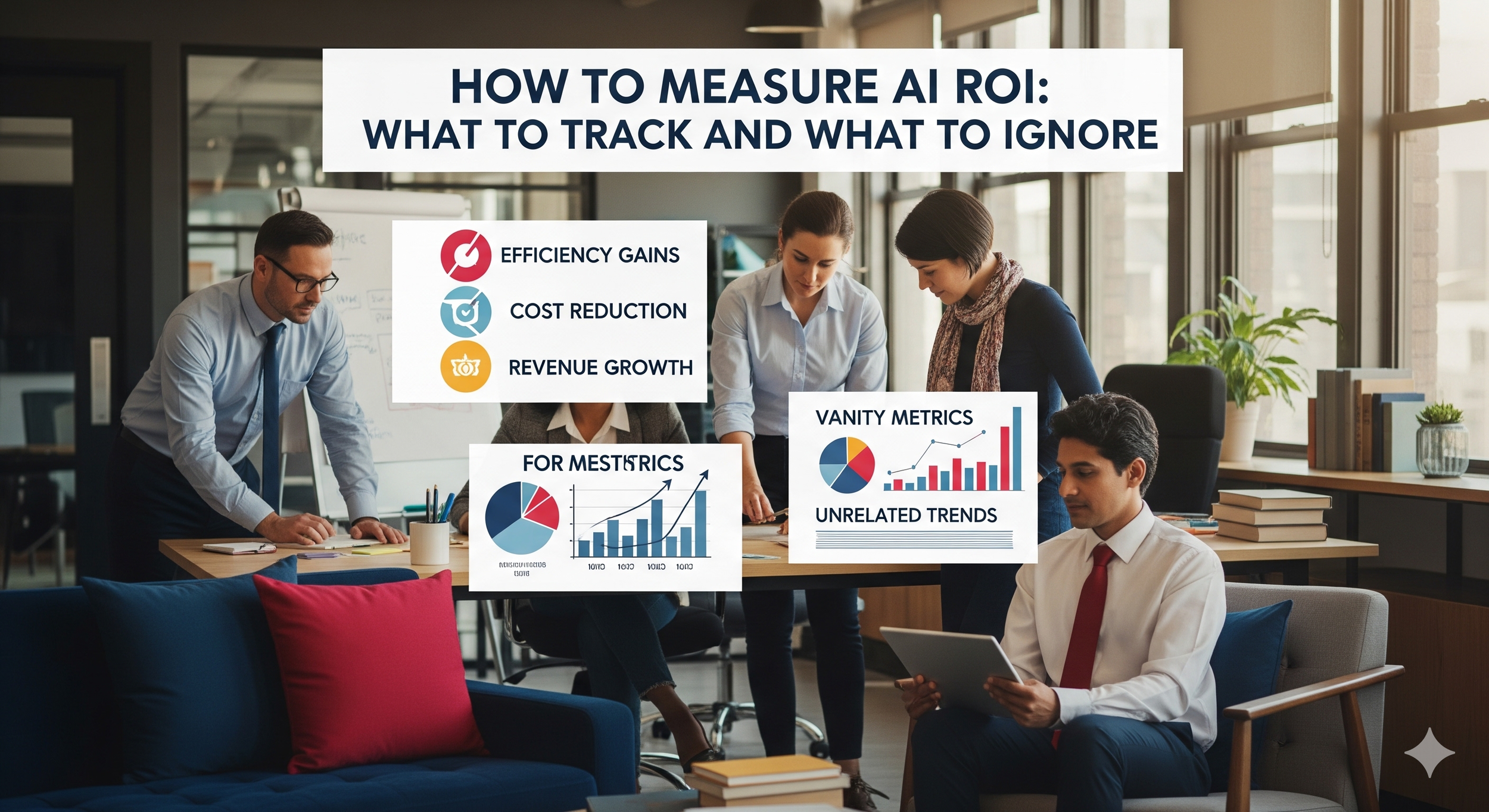
AI investment is increasing across most mid-sized businesses. So is the pressure to demonstrate that it's working. But measuring the return on AI investment is harder than measuring most technology investments — and the most natural approach (applying traditional ROI frameworks directly) often produces misleading results that either undervalue what AI is delivering or, worse, justify continued investment in initiatives that aren't actually generating value.
Understanding how to measure AI ROI properly is increasingly important for business leaders who need to make resource allocation decisions and justify AI investment to boards and leadership teams.
Why is measuring AI ROI so difficult?
Three structural features of AI adoption make measurement more complex than traditional technology investment.
First, AI benefits are often diffuse. A CRM with AI-powered lead scoring doesn't generate a line item in your accounts. It improves the conversion rate of a process that involves multiple people, tools, and inputs. Attributing a specific financial outcome to the AI component specifically — rather than to the sales team, the product, the pricing, or other variables — requires careful measurement design.
Second, AI value accrues over time in ways that don't show up in short-term measurement windows. An organisation that invests in AI capability in year one may not see the full financial impact until year two or three, as the capability matures, skills develop, and AI is integrated more deeply into core processes. Applying a 90-day ROI lens to a multi-year capability investment will always produce disappointing results.
Third, some of the most significant AI value is in things that are hard to quantify: decision quality, employee satisfaction, risk reduction, and competitive positioning. These matter to the business but don't show up cleanly in a standard ROI calculation.
What are the right metrics for AI adoption success?
Effective AI measurement uses a layered framework that tracks metrics at three levels: adoption, performance, and business impact.
Adoption metrics measure whether AI is actually being used: active user rates, tool engagement, feature utilisation, and training completion. These are leading indicators — low adoption tells you early that value realisation is at risk, before it shows up in business metrics. Gartner research suggests that tracking adoption within the first 90 days of deployment is one of the strongest predictors of long-term AI programme success.
Performance metrics measure whether AI is doing what it's supposed to do: accuracy rates, error rates, processing times, output quality scores. These vary by use case but should be defined specifically for each AI application. A content generation tool should have quality metrics; a predictive analytics tool should have accuracy metrics; a process automation should have throughput and error rate metrics.
Business impact metrics measure what the AI investment is delivering at the commercial level: revenue impact, cost reduction, time savings converted to capacity, customer satisfaction improvements, and risk reduction. These are the metrics that matter most to leadership and boards, and they require the most careful measurement design to attribute correctly.
How do you build an AI measurement framework?
The most common mistake is trying to measure everything. An effective AI measurement framework focuses on the metrics that matter most for each specific initiative, measured consistently over a meaningful time period.
The framework should be designed before the AI initiative launches, not retrofitted afterwards. This means: defining the specific business outcome the AI investment is intended to deliver; identifying the metrics that will indicate whether that outcome is being achieved; establishing baseline measurements before the AI goes live; defining the measurement cadence (how often, who is responsible, how results are reported); and agreeing on the performance threshold that constitutes success.
For most mid-sized businesses, a simple dashboard tracking 4–6 key metrics per major AI initiative is more useful than a comprehensive measurement system. The goal is decision-useful data — information that tells leadership whether an AI investment is performing as expected and what, if anything, needs to change.
What does good AI ROI look like for a mid-sized business?
Based on research from McKinsey and Deloitte, mid-sized businesses that execute AI adoption well can typically expect measurable productivity improvements of 15–40% in targeted processes within 12–18 months, cost reductions of 10–30% in automated functions, and revenue impact through improved conversion rates, customer retention, or new capability in the range of 5–15%. These ranges are wide because the specific outcome depends heavily on the use case, the quality of the data, and the effectiveness of the adoption programme.
The single most important predictor of AI ROI isn't the technology chosen — it's the completeness of the adoption approach. Businesses that invest in strategy, technology, and people in combination consistently outperform those that invest in technology alone. This is consistently the most important finding in the research on AI adoption outcomes, and it's the experience we see in practice.
Measurement is itself part of a complete adoption approach. Businesses that measure rigorously, learn from what the data tells them, and adjust their approach accordingly are the ones that turn initial AI investments into compounding advantage over time.
Frequently Asked Questions
When should we start measuring AI ROI? Measurement should start before the AI initiative launches, with baseline data. Adoption metrics should be tracked from day one of go-live. Performance metrics typically take 4–8 weeks to stabilise as users become proficient and the AI system learns from live data. Business impact metrics should be assessed at 3, 6, and 12 months, with the expectation that the 12-month data will be the most meaningful.
What's a realistic timeframe for positive AI ROI? For well-executed initiatives targeting clear productivity or cost outcomes, positive ROI within 6–12 months is achievable. For more complex capability-building programmes, 12–18 months is more realistic. The key variable is whether the investment was scoped correctly in the first place — AI initiatives with vague or over-broad objectives consistently take longer to deliver measurable returns than those with specific, well-defined success criteria.
Who should own AI measurement in the business? AI measurement is most effective when owned jointly by the business leader of the function where the AI is deployed and the team managing the AI adoption programme. The function leader owns the business impact metrics (they're accountable for the commercial outcome); the adoption team owns the adoption and performance metrics. Where these two groups review data together regularly, the feedback loop between technical performance and business outcome is much tighter, and course-correction happens faster.
Not sure where your business stands with AI?
Find out your AiDOPTION Score — a free 10-minute diagnostic that measures your AI readiness across Strategy, Technology, and People. You'll get a personalised score and practical recommendations.

The AI Pilot Trap: Why Your Experiments Aren't Turning Into Results
Many mid-sized businesses have been running AI experiments for months — sometimes years. A chatbot here, an automation there, a team using an AI writing tool. Some of these pilots have been genuinely impressive. But they haven't turned into business results at scale. The business is still waiting for the breakthrough moment.

Many mid-sized businesses have been running AI experiments for months — sometimes years. A chatbot here, an automation there, a team using an AI writing tool. Some of these pilots have been genuinely impressive. But they haven't turned into business results at scale. The business is still waiting for the breakthrough moment.
This is the AI pilot trap. And it's one of the most common patterns we see in organisations that are trying to adopt AI seriously but aren't getting the commercial outcomes they were promised.
What is the AI pilot trap?
The AI pilot trap is the state where an organisation has multiple AI experiments running simultaneously — some of which show genuine promise — but none of them have scaled into standard operating practice, and the aggregate impact on the business is negligible.
It's characterised by a few telltale signs: a growing list of "proof of concept" projects that never graduate to production; a small group of enthusiastic early adopters surrounded by a much larger group of people who haven't engaged with AI at all; positive pilot reports that don't translate into measurable business metrics; and increasing frustration at the leadership level that AI investment isn't delivering returns.
According to BCG research, roughly 70% of companies have launched AI pilots, but fewer than 30% have successfully scaled their AI initiatives across the business. The pilot trap is the norm, not the exception.
Why do AI pilots succeed but fail to scale?
There are several structural reasons why pilots work in isolation but stall at scale, and understanding them is the first step to breaking out of the trap.
First, pilots are typically run by the most motivated people in the organisation — early adopters who are intrinsically interested in AI and willing to invest personal time to make it work. These people can make almost anything succeed in a controlled environment. Scaling requires getting less motivated, less technical people to the same level of capability. That's a fundamentally different challenge.
Second, pilots rarely surface the integration challenges that come at scale. A standalone AI tool can run on its own data without touching existing systems. When you try to embed that same capability into actual business workflows, you hit data quality problems, integration complexity, and security requirements that simply don't exist in a sandboxed experiment.
Third, pilots are rarely designed with scaling in mind. Success metrics are usually about the technology working, not about business impact. When leadership asks "what did we get for this?", there's often no clear answer — because the pilot wasn't designed to measure business outcomes.
How do you break out of the AI pilot trap?
Breaking out of the pilot trap requires a fundamental shift in how you think about AI adoption — from experimentation to strategy.
The first step is to audit your current pilots honestly. What are you running? What did it cost? What business outcome was it designed to deliver? What's the measured result? Many organisations have never done this rigorously, and when they do, they find that most of their AI investment is dispersed across low-value experiments rather than concentrated on high-value outcomes.
The second step is to define clear AI priorities at the business level. Not "we want to use AI" but "we want AI to reduce our customer service response time by 40% in the next 12 months." Specificity forces you to choose, allocate resources, and measure outcomes. Without it, you end up spreading effort across everything and achieving impact in nothing.
The third step is to build a path from pilot to production. This means defining, before you start, what success looks like, what scale looks like, and what the steps are between a working prototype and a live business capability. Governance, integration, training, and change management all need to be planned before the pilot starts, not bolted on afterwards.
What's the difference between an AI experiment and an AI strategy?
An AI experiment is a test of whether a technology can do something. An AI strategy is a plan for using technology to achieve specific business outcomes. The difference sounds simple, but in practice it's significant.
An experiment asks: "Can AI do this?" A strategy asks: "What should AI do to make our business better, by how much, and how will we make that happen?" The strategy has a target, a timeline, a resource allocation, a measurement framework, and an owner. The experiment has a hypothesis and a sandbox.
Most businesses in the AI pilot trap have lots of experiments and no strategy. The path out is to stop asking whether AI can do things and start asking what you actually want it to deliver — then build backward from that answer.
Frequently Asked Questions
How many AI pilots is too many? There's no magic number, but if your organisation is running more pilots than it can actively monitor, resource, and assess — you have too many. Three to five focused pilots with clear success criteria is generally far more productive than fifteen loosely managed experiments. Fewer, better-designed pilots lead to faster, more credible learnings.
When should we stop piloting and start scaling? A pilot is ready to scale when it has demonstrated measurable business impact (not just technical success), has a clear integration path into existing systems and workflows, and has an owner who is accountable for the scaled outcome. If you can't answer all three, the pilot isn't ready — regardless of how impressive it looks in a demo.
What does a successful pilot-to-production path look like? It starts with a clear definition of "done" at the pilot stage — specific metrics, not general impressions. Then it moves through a structured scale-up: technical integration, data governance, user training, change management, and a phased rollout with checkpoints. The key is treating the transition from pilot to production as its own project, with its own timeline and resources — not an afterthought.
Not sure where your business stands with AI?
Find out your AiDOPTION Score — a free 10-minute diagnostic that measures your AI readiness across Strategy, Technology, and People. You'll get a personalised score and practical recommendations.

30 Years in Technology Taught Me This About AI: It's Different This Time
I've been working in technology since the early 1990s. I've lived through the commercialisation of the internet, the dot-com boom and bust, the arrival of mobile, the rise of cloud computing, social media, and a dozen other waves that were each described, at the time, as the most transformative technology shift in a generation.
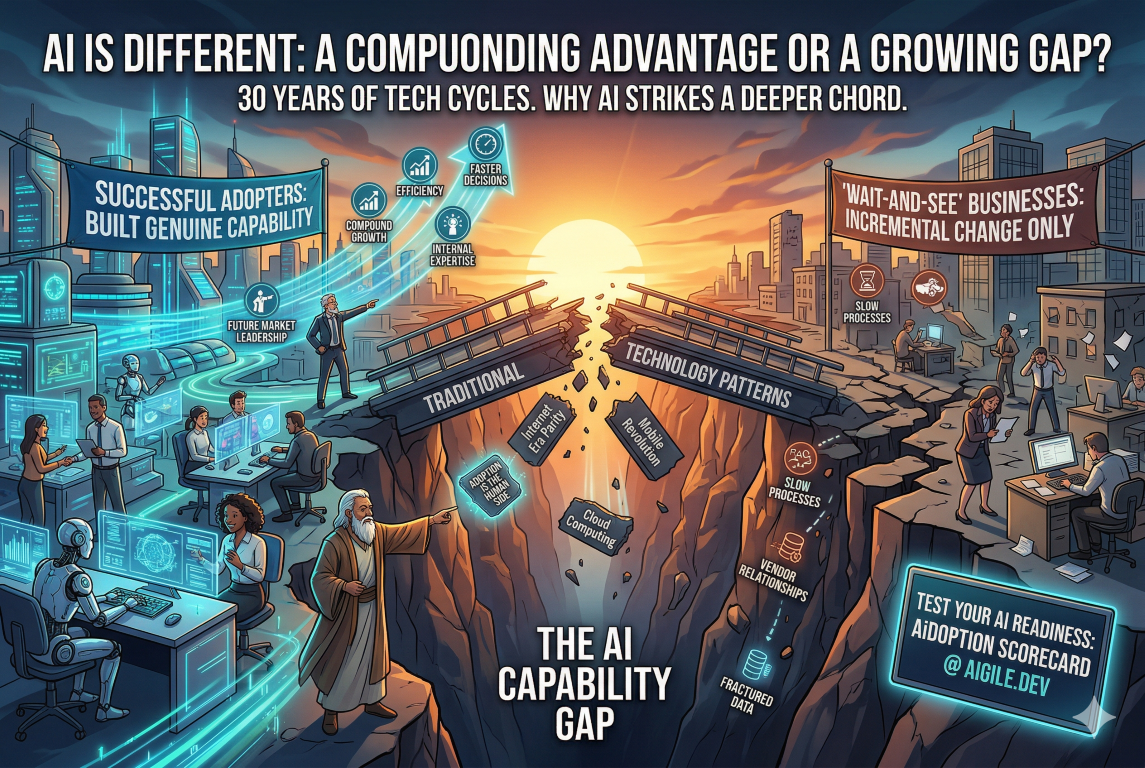
I've been working in technology since the early 1990s. I've lived through the commercialisation of the internet, the dot-com boom and bust, the arrival of mobile, the rise of cloud computing, social media, and a dozen other waves that were each described, at the time, as the most transformative technology shift in a generation.
So when I tell you that AI is different — genuinely different, in ways that make most of what we've experienced before look like incremental change — I want you to understand that it's not something I say lightly. And I want to explain why, based on three decades of watching technology cycles, I believe that.
Why does every technology cycle feel different — and why this one actually is?
Every major technology wave comes with a version of the same claim: this changes everything. And in most cases, the claim is both true and overstated. The internet did change everything. It also took fifteen years to fully manifest in mainstream business practice, and the "everything" it changed was more narrowly defined than the early evangelists suggested.
The pattern I've observed across multiple cycles is consistent: initial excitement, early adoption by the technically bold, a reality check when the hard implementation challenges emerge, gradual maturation, and eventually mainstream adoption that is genuinely transformative but slower and less dramatic than the peak of the hype cycle suggested.
AI is following this pattern. But there are three things about this wave that make it substantively different from everything I've worked with before, and they have direct implications for how mid-sized businesses should be thinking about their response.
What have 30 years of technology change taught me about adoption?
The most consistent lesson from 30 years of digital product development is that technology succeeds when it solves real problems for real people and fails when it's deployed for its own sake. This sounds obvious, but it's violated constantly.
I've seen large organisations spend years and significant capital on technology implementations that never delivered meaningful business outcomes because the adoption question was never properly answered. The technology worked. The people didn't change. And a technology that nobody uses delivers no value regardless of its capability.
The second consistent lesson is that the human side of technology adoption is always the harder problem. Technical implementation, while complex, is typically more predictable than people change. The businesses that succeed with technology consistently invest disproportionately in change management, training, and culture — not just infrastructure and software.
The third lesson is that the organisations that build genuine capability — rather than buying a solution and assuming it will work — compound their advantage over time. The businesses I've seen succeed with every major technology wave are those that developed internal expertise, not just vendor relationships.
How is AI different from every previous technology wave?
Three things distinguish this wave from what came before.
First, the breadth of application is unprecedented. Previous technology waves had wide but ultimately bounded impacts. The internet transformed information exchange and commerce. Mobile transformed communication and location-based services. AI has the potential to augment almost every cognitive task performed in almost every business function. The scope is genuinely different.
Second, the pace of capability development is accelerating in a way that previous technology waves didn't. The internet developed quickly. But the capability curve for AI — the rate at which systems are becoming more capable — is steeper and shows fewer signs of plateauing. Businesses are in a position where the landscape is changing under their feet in real time, not just at product launch cycles.
Third, AI is for the first time creating a meaningful capability gap between businesses that adopt it well and those that don't at the level of everyday operational work. Previous technology waves largely created parity — when everyone has a website, having a website doesn't differentiate you. AI, done well, builds into a compounding advantage: better processes, better decisions, better products, delivered faster, at lower cost. That gap, once established, is hard to close.
What does this mean for business leaders today?
It means the strategic response can't be "wait and see." The businesses that wait for AI to mature before engaging will find themselves behind a curve that's already steep and getting steeper.
It also doesn't mean running at every AI opportunity simultaneously. The businesses I've seen succeed with major technology transitions are those that make deliberate, strategic choices about where to focus, build deep capability in those areas, and then expand from a position of genuine competence rather than scattered experimentation.
The question isn't whether to adopt AI. It's how to do it in a way that builds lasting capability — in your strategy, your technology, and most importantly, your people. Those three things together are what turn AI investment into business outcomes that actually show up in your results.
That's why I founded AiGILE. Not to sell technology, but to help businesses build the genuine AI capability that I've seen make the difference, over and over, for thirty years.
Frequently Asked Questions
Is AI really different from previous automation waves? Yes, in a meaningful way. Previous automation waves primarily replaced repetitive physical tasks (manufacturing) or highly structured cognitive tasks (data processing). AI can augment and in some cases replace judgment-intensive, unstructured cognitive work — writing, analysis, design, strategy support, and customer interaction. The scope of what can be affected is substantially broader than previous automation.
How long will it take for AI to fully transform most businesses? Based on historical technology adoption patterns, mainstream transformation of business operations will take 7–15 years. But the leading adopters will build substantial advantages within 2–5 years that will be very difficult for laggards to close. The question isn't about the end state — it's about where you want to be in the competitive landscape in three to five years.
What's the first thing a business leader should do about AI today? Understand where your business currently stands. Not with a gut feeling, but with a structured assessment across strategy, technology, and people dimensions. You can't make good decisions about where to invest without an honest baseline. The AiDOPTION Scorecard is designed to give you exactly that — a clear, specific picture of your current AI readiness and where the priority gaps are.
Not sure where your business stands with AI?
Find out your AiDOPTION Score — a free 10-minute diagnostic that measures your AI readiness across Strategy, Technology, and People. You'll get a personalised score and practical recommendations.

Why Most AI Adoption Fails: The Change Management Problem Nobody Talks About
Most AI adoption conversations start with technology. Which platform? Which tools? How much compute? It's understandable — the technology is genuinely exciting, and it's the most visible part of the process. But it's rarely where AI adoption actually breaks down.

Most AI adoption conversations start with technology. Which platform? Which tools? How much compute? It's understandable — the technology is genuinely exciting, and it's the most visible part of the process. But it's rarely where AI adoption actually breaks down.
The real reason most mid-sized businesses don't see meaningful results from AI isn't the technology. It's the people. Specifically, it's the absence of a structured approach to managing the change that AI represents for their workforce.
Why do so many AI initiatives fail despite good technology?
The numbers are striking. McKinsey research consistently shows that around 70% of large-scale change programmes fail to meet their objectives — and AI adoption is no different. Organisations invest in tools, roll out access, and then wonder why usage is low, results are patchy, and teams are quietly reverting to old ways of working.
The answer is almost always the same: the technology was deployed, but the change wasn't managed. People weren't given the context to understand why AI was being introduced. They weren't given the skills to use it effectively. They weren't given the reassurance that their jobs were secure. And so they did what humans naturally do when faced with an uncertain change — they resisted it, quietly and persistently.
This isn't a failure of the technology. It's a failure of change management.
What is change management in the context of AI adoption?
Change management is the structured process of preparing, supporting, and guiding people through a significant organisational change. In the context of AI adoption, it means helping employees understand what AI means for their role, building the skills and confidence they need to work alongside it, and creating the conditions where AI becomes part of normal working practice — not a mandated tool that people tolerate.
Effective AI change management covers five interconnected areas:
Leadership alignment — ensuring leaders are clear on why AI is being adopted, how it connects to business strategy, and what their role is in driving the change. Without this, mixed messages cascade through the organisation.
Communication — timely, honest, and consistent communication about what's happening, why it's happening, and what it means for different teams. Silence is interpreted as threat. Clarity builds trust.
Capability building — providing training and learning support that meets people where they are. Not a one-off workshop, but ongoing development that builds real fluency over time.
Support structures — helpdesks, AI champions, peer networks, and feedback mechanisms that give people somewhere to go when they're stuck or uncertain.
Measurement and adjustment — tracking adoption, monitoring sentiment, and actively adjusting the approach based on what's working and what isn't.
How do you build a change management plan for AI adoption?
The starting point is stakeholder analysis — mapping who is affected by the AI adoption, how significantly, and what their primary concerns are likely to be. The experience of a finance analyst whose workflow is being automated is very different from a customer service manager whose team is getting an AI co-pilot. Change management that treats everyone the same will resonate with no one.
From there, a communication plan needs to be developed. This should define who says what, to whom, at what stage of the adoption journey. Gartner research on technology adoption highlights that the timing of communications matters as much as the content — too early and people fixate on uncertainty, too late and they feel blindsided.
Training and capability-building then needs to be sequenced to follow communication, not precede it. People learn better when they understand the "why" before they tackle the "how." Learning programmes should be varied, practical, and role-specific, combining formal training with on-the-job support.
Finally, a feedback mechanism needs to be built in from day one. Pulse surveys, manager check-ins, and usage data all provide signals about how the adoption is landing and where additional support is needed.
What does successful AI change management look like in practice?
Businesses that manage AI change well share a few common characteristics. Leaders are visible and positive about the transition — not just in written communications, but in how they talk about AI in meetings and how they model its use. Communication is honest about both the opportunities and the challenges, rather than relentlessly optimistic in a way that erodes trust.
Learning is treated as ongoing rather than one-off. Staff have access to support when they need it, not just at the moment of go-live. And there's a clear measurement framework in place so the organisation knows whether adoption is actually happening — and can intervene if it isn't.
Most importantly, successful AI change management starts early. By the time a new AI tool is ready to deploy, the change management groundwork should already be well underway. Retrofitting change management to a failed rollout is considerably harder than building it in from the start.
Frequently Asked Questions
How long does change management take during AI adoption? There's no single answer — it depends on the scale of the change, the size of the organisation, and the existing change maturity. A focused AI tool rollout in one department might require 6–8 weeks of structured change support. A whole-of-business AI adoption programme could run for 12–18 months. As a rule of thumb, if the timeline feels too short for the change management component, it probably is.
Can a mid-sized business handle change management internally? Yes, with the right support. Internal HR and communications teams often have much of the capability needed. Where specialist help adds the most value is in the design phase — building the initial framework, stakeholder mapping, and communication strategy — and in specific skills like capability assessment and facilitation of leadership alignment sessions.
What's the biggest sign that change management is being neglected? Low adoption rates despite high access to tools. If you've rolled out an AI platform and only 20–30% of users are actively using it after several weeks, the technology isn't the problem. The experience gap — the distance between what the tool can do and what people feel confident doing with it — is the problem. That's a change management challenge.
Not sure where your business stands with AI?
Find out your AiDOPTION Score — a free 10-minute diagnostic that measures your AI readiness across Strategy, Technology, and People. You'll get a personalised score and practical recommendations.