
30 Years in Technology Taught Me This About AI: It's Different This Time
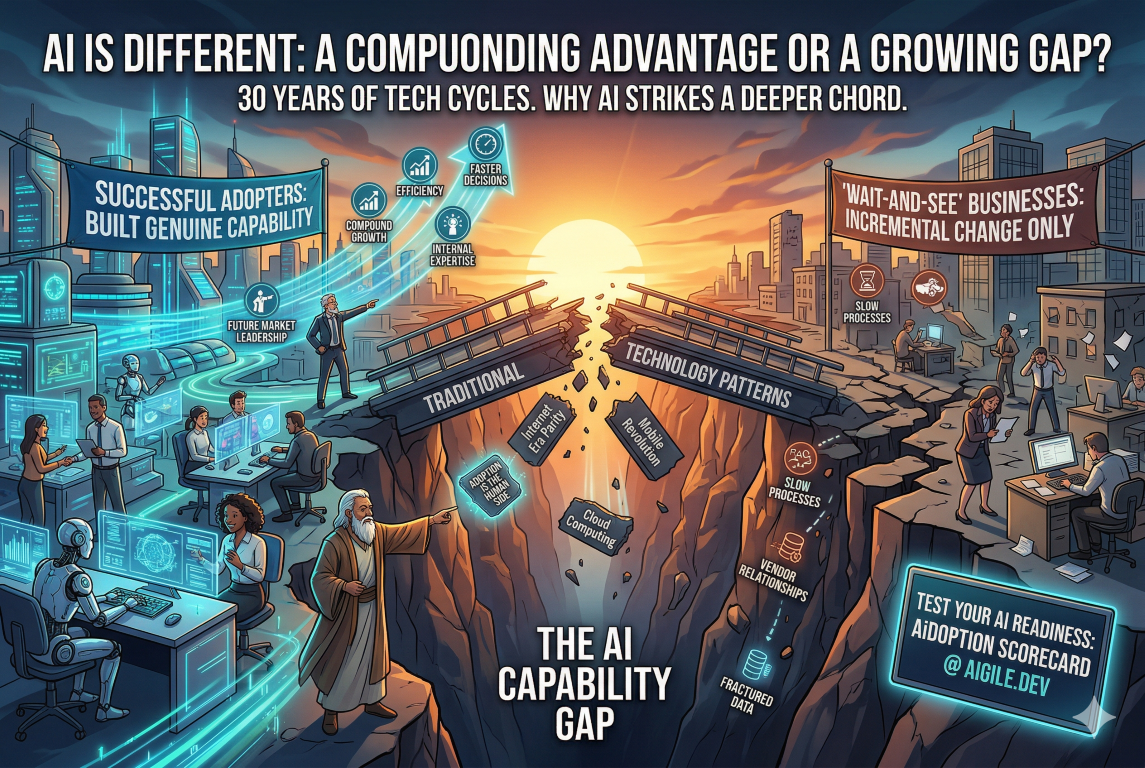
I've been working in technology since the early 1990s. I've lived through the commercialisation of the internet, the dot-com boom and bust, the arrival of mobile, the rise of cloud computing, social media, and a dozen other waves that were each described, at the time, as the most transformative technology shift in a generation.
So when I tell you that AI is different — genuinely different, in ways that make most of what we've experienced before look like incremental change — I want you to understand that it's not something I say lightly. And I want to explain why, based on three decades of watching technology cycles, I believe that.
Why does every technology cycle feel different — and why this one actually is?
Every major technology wave comes with a version of the same claim: this changes everything. And in most cases, the claim is both true and overstated. The internet did change everything. It also took fifteen years to fully manifest in mainstream business practice, and the "everything" it changed was more narrowly defined than the early evangelists suggested.
The pattern I've observed across multiple cycles is consistent: initial excitement, early adoption by the technically bold, a reality check when the hard implementation challenges emerge, gradual maturation, and eventually mainstream adoption that is genuinely transformative but slower and less dramatic than the peak of the hype cycle suggested.
AI is following this pattern. But there are three things about this wave that make it substantively different from everything I've worked with before, and they have direct implications for how mid-sized businesses should be thinking about their response.
What have 30 years of technology change taught me about adoption?
The most consistent lesson from 30 years of digital product development is that technology succeeds when it solves real problems for real people and fails when it's deployed for its own sake. This sounds obvious, but it's violated constantly.
I've seen large organisations spend years and significant capital on technology implementations that never delivered meaningful business outcomes because the adoption question was never properly answered. The technology worked. The people didn't change. And a technology that nobody uses delivers no value regardless of its capability.
The second consistent lesson is that the human side of technology adoption is always the harder problem. Technical implementation, while complex, is typically more predictable than people change. The businesses that succeed with technology consistently invest disproportionately in change management, training, and culture — not just infrastructure and software.
The third lesson is that the organisations that build genuine capability — rather than buying a solution and assuming it will work — compound their advantage over time. The businesses I've seen succeed with every major technology wave are those that developed internal expertise, not just vendor relationships.
How is AI different from every previous technology wave?
Three things distinguish this wave from what came before.
First, the breadth of application is unprecedented. Previous technology waves had wide but ultimately bounded impacts. The internet transformed information exchange and commerce. Mobile transformed communication and location-based services. AI has the potential to augment almost every cognitive task performed in almost every business function. The scope is genuinely different.
Second, the pace of capability development is accelerating in a way that previous technology waves didn't. The internet developed quickly. But the capability curve for AI — the rate at which systems are becoming more capable — is steeper and shows fewer signs of plateauing. Businesses are in a position where the landscape is changing under their feet in real time, not just at product launch cycles.
Third, AI is for the first time creating a meaningful capability gap between businesses that adopt it well and those that don't at the level of everyday operational work. Previous technology waves largely created parity — when everyone has a website, having a website doesn't differentiate you. AI, done well, builds into a compounding advantage: better processes, better decisions, better products, delivered faster, at lower cost. That gap, once established, is hard to close.
What does this mean for business leaders today?
It means the strategic response can't be "wait and see." The businesses that wait for AI to mature before engaging will find themselves behind a curve that's already steep and getting steeper.
It also doesn't mean running at every AI opportunity simultaneously. The businesses I've seen succeed with major technology transitions are those that make deliberate, strategic choices about where to focus, build deep capability in those areas, and then expand from a position of genuine competence rather than scattered experimentation.
The question isn't whether to adopt AI. It's how to do it in a way that builds lasting capability — in your strategy, your technology, and most importantly, your people. Those three things together are what turn AI investment into business outcomes that actually show up in your results.
That's why I founded AiGILE. Not to sell technology, but to help businesses build the genuine AI capability that I've seen make the difference, over and over, for thirty years.
Frequently Asked Questions
Is AI really different from previous automation waves? Yes, in a meaningful way. Previous automation waves primarily replaced repetitive physical tasks (manufacturing) or highly structured cognitive tasks (data processing). AI can augment and in some cases replace judgment-intensive, unstructured cognitive work — writing, analysis, design, strategy support, and customer interaction. The scope of what can be affected is substantially broader than previous automation.
How long will it take for AI to fully transform most businesses? Based on historical technology adoption patterns, mainstream transformation of business operations will take 7–15 years. But the leading adopters will build substantial advantages within 2–5 years that will be very difficult for laggards to close. The question isn't about the end state — it's about where you want to be in the competitive landscape in three to five years.
What's the first thing a business leader should do about AI today? Understand where your business currently stands. Not with a gut feeling, but with a structured assessment across strategy, technology, and people dimensions. You can't make good decisions about where to invest without an honest baseline. The AiDOPTION Scorecard is designed to give you exactly that — a clear, specific picture of your current AI readiness and where the priority gaps are.
Not sure where your business stands with AI?
Find out your AiDOPTION Score — a free 10-minute diagnostic that measures your AI readiness across Strategy, Technology, and People. You'll get a personalised score and practical recommendations.