
The AI Skills Gap Is Here. Is Your Team Ready?
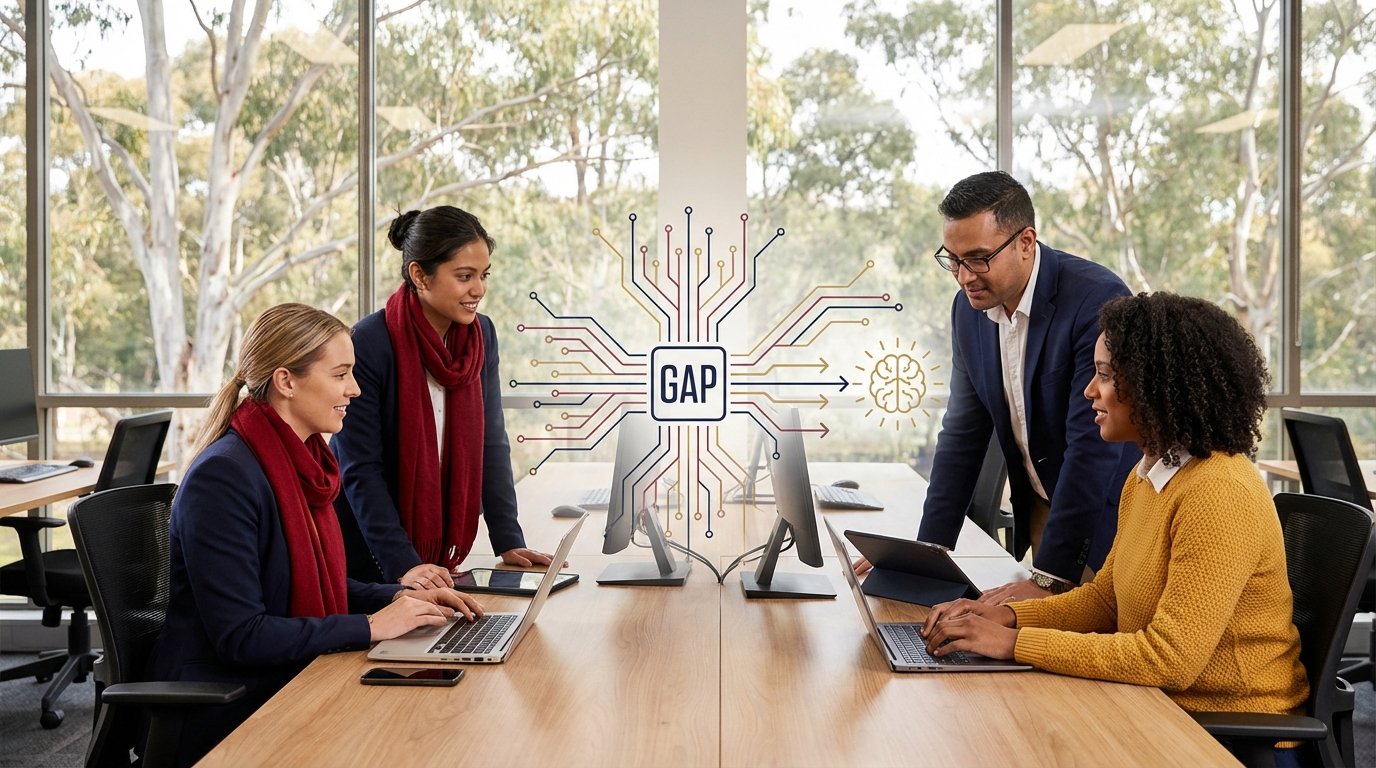
Every significant technology transition creates a skills gap. The internet created demand for web developers, digital marketers, and e-commerce specialists that didn't exist a decade earlier. Mobile created demand for app developers and UX designers. AI is creating its own wave of new skill requirements — and unlike previous transitions, it's affecting almost every role across almost every function.
For mid-sized businesses, the AI skills gap represents both a risk and an opportunity. The risk is being outpaced by competitors who invest in building AI capability earlier and more systematically. The opportunity is that businesses that invest in their people's AI skills now will compound that advantage over time.
What is the AI skills gap and why does it matter now?
The AI skills gap is the difference between the skills employees currently have and the skills they need to work effectively in an AI-enabled environment. It's not primarily about knowing how to build AI systems — that's a technical specialisation. It's about knowing how to use AI tools effectively in everyday work, understanding AI's capabilities and limitations, knowing how to evaluate AI outputs critically, and being able to adapt workflows to take advantage of AI assistance.
Research from McKinsey and BCG consistently shows that the biggest barrier to AI adoption isn't the technology — it's the people. A 2024 BCG survey found that more than 80% of organisations identified employee capability as one of their top two barriers to scaling AI. The technology is advancing faster than the workforce's ability to use it effectively.
The urgency is real. Businesses that wait for the AI skills question to resolve itself — hoping employees will pick up what they need organically — are accumulating a gap that becomes progressively harder to close.
What skills do employees actually need for AI?
AI skills fall into three levels, and not all employees need all three.
Foundational AI literacy applies to everyone. This means understanding what AI can and can't do, knowing which tools are available and appropriate for which tasks, being able to spot when AI output needs checking, and understanding the basic principles of responsible AI use (privacy, accuracy, attribution). This level of skill should be universal across the organisation.
Functional AI proficiency applies to anyone whose role involves significant use of AI tools. This means being able to write effective prompts to get high-quality outputs, use AI tools efficiently as part of day-to-day workflows, critically evaluate and edit AI-generated content, and apply AI appropriately to the specific demands of their function.
Advanced AI capability applies to a smaller group of people — analysts, developers, and process owners — who need to configure AI tools, design AI-enabled workflows, or work with AI in technically complex ways. This level typically requires more formal training and often a technical background.
How do you assess your team's current AI capability?
The starting point is an honest, structured capability assessment. This isn't just a survey asking whether people have used AI tools — it needs to assess actual proficiency across the dimensions that matter for your business.
A basic capability assessment covers: current AI tool usage (what, how often, for what purpose); self-assessed confidence in using AI effectively; understanding of AI's limitations and responsible use principles; and function-specific skill requirements. This should be done at the team level, not just individually, because the unit of deployment is usually a team workflow rather than an individual task.
The assessment should produce a clear picture of where your workforce currently sits across the three levels, where the priority gaps are relative to your AI strategy, and which teams or functions need the most investment to close those gaps.
What's the best approach to building AI skills in your workforce?
The single biggest mistake organisations make with AI skill-building is treating it as a one-off training exercise. A single workshop or e-learning module doesn't build lasting capability. Skill development that actually changes how people work requires a sustained, multi-modal approach.
Effective AI capability-building combines formal learning (structured training on specific tools and principles) with experiential learning (applying AI in real work tasks with coaching support), peer learning (AI champions and communities of practice within the organisation), and self-directed learning (access to resources for ongoing development). The mix should be designed around the specific needs and learning preferences of different groups, not as a one-size approach.
Critically, skill-building should be connected to the specific AI tools and workflows the organisation is adopting — not generic AI content. Learning is most effective when it's immediately applicable to real work. Employees who understand why they're learning something, and can use it the next day, develop skills far faster than those learning in the abstract.
Frequently Asked Questions
Do all employees need AI skills or just specific teams? At the foundational level — basic AI literacy and responsible use principles — yes, this should be universal. AI is increasingly present in the tools most employees use every day, whether or not those employees are consciously aware of it. Functional and advanced skills can be targeted to the roles and teams where they'll have the most impact. A phased approach, starting with high-impact functions and expanding over time, is practical for most mid-sized businesses.
Is "training" enough to close the AI skills gap? Training alone is not enough. Research consistently shows that skills learned in isolation don't transfer reliably to real-world application without reinforcement. Effective capability-building requires training, practice plus support. This is why we at AiGILE use the term "learning" rather than "training" — it signals a broader approach that goes beyond a one-off programme to build genuine, lasting capability.
How long does it take to build meaningful AI capability in a team? For foundational AI literacy, a well-designed programme can produce meaningful improvement in 4–6 weeks. For functional proficiency with specific tools, typically 8–12 weeks of supported practice is required to reach reliable competence. Advanced capability development is more variable, but typically 3–6 months of structured learning and application. The key variable is whether learning is connected to real work — theoretical learning alone takes longer and sticks less well.
Not sure where your business stands with AI?
Find out your AiDOPTION Score — a free 10-minute diagnostic that measures your AI readiness across Strategy, Technology, and People. You'll get a personalised score and practical recommendations.